The State of Play: Australian Residential Construction Safety in 2026
The Australian residential construction sector enters mid-2026 carrying a pipeline of new houses and multi-residential apartments at decade highs. Labour shortages persist, material costs remain elevated, and builders across four states are running fast to meet demand. In that environment, height safety has moved from a compliance checkbox to a critical operational priority. State regulators are tightening enforcement, lowering thresholds, and pushing the industry toward engineered physical barriers rather than solely administrative controls.
This guide maps the regulatory position in NSW, Queensland, Victoria and South Australia as of mid-2026 (all states Buildsafe currently operates in), sets out the falls-specific hierarchy of controls that underpins every state’s approach, and explains how national operators like Buildsafe are bridging the gap between what the legislation demands and what builders need on site.
State-by-state: Legislation and Governing Bodies
New South Wales
NSW is operating under the Building and Construction Work Health and Safety Blueprint to 2026, a three-year plan from SafeWork NSW that targets a 20 per cent reduction in incidents across falls from heights, electrical contact and moving plant.
The primary legislation is the Work Health and Safety Regulation 2025 (which remade and replaced the WHS Regulation 2017 in August 2025; the construction provisions carry over with editorial updates). SafeWork NSW inspectors are enforcing the hierarchy of controls with a strict stance on inadequate edge protection, particularly on residential sites where scaffold or guard rail is reasonably practicable but has not been installed.
Regulator: SafeWork NSW
Queensland
Queensland’s construction pipeline is surging on the back of the Road to 2032 Olympics infrastructure programme. Class 1 (houses) and Class 2 (apartments) approvals are elevated across South East Queensland, and the competition for skilled workers between residential sites and publicly funded mega-projects is well documented. For a detailed look at what the 2032 pipeline means for the building sector, see our analysis of Queensland’s road to 2032.
For residential site work at height, the key technical references are the Scaffolding Code of Practice 2021 for scaffold-related edge protection and the broader Managing the Risk of Falls at Workplaces Code of Practice 2021 for falls management generally.
Regulator: Workplace Health and Safety Queensland
Victoria
Insolvencies have challenged the Victorian residential market, but demand for high-density builds in Melbourne remains strong. Victoria operates under its own Occupational Health and Safety Act 2004 (Victoria opted out of the national harmonised WHS framework and retains the OHS Act rather than WHS). WorkSafe Victoria emphasises that PCBUs must provide the highest level of fall protection (scaffold or guard rail) that is reasonably practicable, rather than defaulting to lower-level controls like harnesses. The scaffolding industry standard was published in 2024, with enforcement beginning in December 2025. The practical effect is a strong regulatory push toward collective protection first.
Regulator: WorkSafe Victoria
South Australia
2026 is a landmark year for SA. As of 1 July 2026, the threshold for High Risk Construction Work involving falls drops from 3m to 2m. The change was introduced by the Work Health and Safety (High Risk Construction Work) Amendment Regulations 2025, bringing SA into line with the lower threshold applied under the national model WHS framework in most other states.
The consequence for builders: almost all residential roofing and second-storey work at height now triggers the high-risk duties. That means a Safe Work Method Statement (SWMS) before the work starts, and the fall risk managed through the hierarchy of controls. It does not mandate any single product; it requires the risk to be controlled and the control to be documented. For a detailed breakdown, see our fall protection compliance guide.
Regulator: SafeWork SA
Managing The Height Hazard: The Falls-specific Hierarchy of Controls
Across all four states, the 2026 regulatory focus is on engineered physical barriers. The falls-specific hierarchy of controls (set out in the Model Code of Practice: Managing the Risk of Falls at Workplaces, published by Safe Work Australia) is the decision framework that every state regulator expects builders to follow when a fall risk exists.
| Level | Control Type | On-Site Example |
|---|---|---|
| 1 | Work on the ground or a solid construction | Prefabricate at ground level then lift into place. |
| 2 | Passive fall-prevention device | Scaffold, edge protection, guard rail, safety mesh, EWPs. |
| 3 | Work-positioning system | Travel restraint, industrial rope access. |
| 4 | Fall-injury minimisation system | Fall-arrest systems (harnesses, safety nets). It is important to note that these controls are usually not suitable for residential construction sites. Fall restraint requires specialist equipment and training; for fall arrest, there is usually not enough height clearance to be effective. |
You start at the top and only move down a level when a higher control is not reasonably practicable for the work. The order matters because Level 2 controls protect the entire crew with a physical barrier; Level 4 controls rely on each individual worker to wear and use equipment correctly. Regulators in every state are clear that a harness is a last resort, not a starting point.
This is the falls-specific hierarchy, distinct from the general WHS hierarchy of controls (eliminate, substitute, isolate, engineer, admin, PPE). The two complement each other. The general hierarchy applies to any workplace hazard; the falls hierarchy is a purpose-built decision tree for work at height, and it is the framework you will encounter in the Codes of Practice that state regulators reference for construction.
What this means for residential builders
For a single-storey residential build in SA (post 1 July 2026), a roof height that puts workers above 2m now requires documented controls. The hierarchy says: can you do the work at ground level? If not, can you install edge protection or scaffold? Only after those are ruled out should individual PPE or administrative controls enter the picture. The practical result is that more residential sites need scaffold or roof rail as a baseline, and the documentation (SWMS, handover certificates, engineering sign-off) needs to be in order before the work starts.
National Leadership: The Buildsafe Approach
Operating across NSW, Queensland, Victoria and South Australia, Buildsafe has built its national position around three things that matter to a builder running sites across state lines.
Compliance documentation that travels
Legislation varies by state, and a builder working in Brisbane and Adelaide needs documentation that satisfies both sets of requirements. Buildsafe’s compliance package (known as The Orange Box) delivers a complete digital set of credentials, handover certificates and engineering audits for every installation. The result is that builders are audit-ready regardless of which state regulator walks on site.
Systems designed for productivity
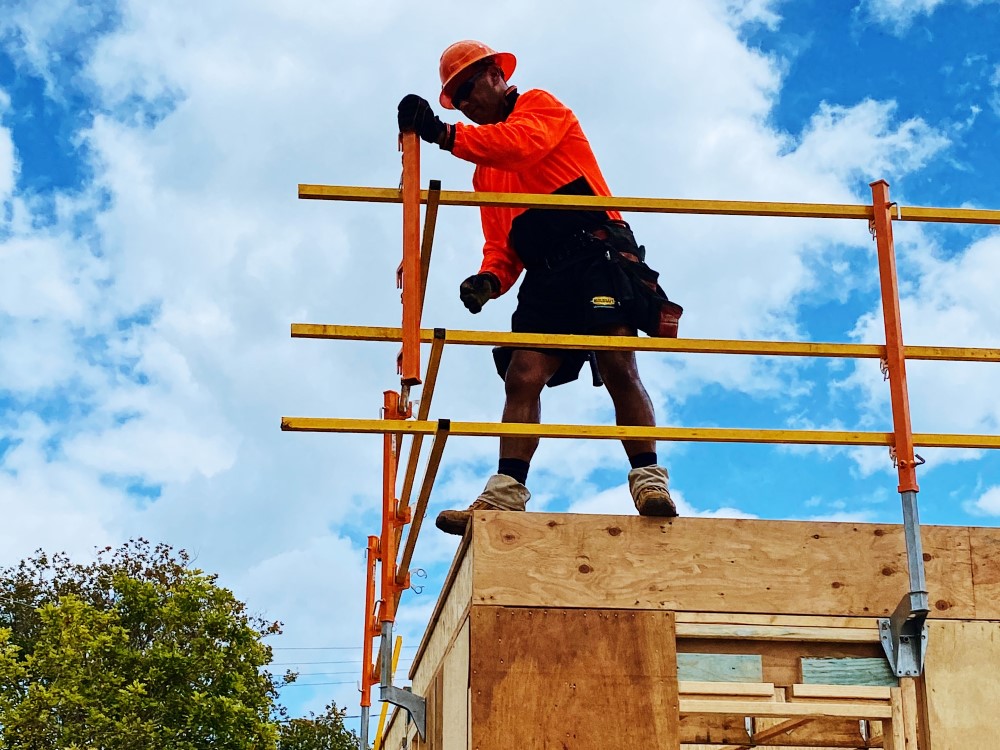
Height safety systems that slow down the trades are systems that get worked around. Buildsafe’s edge protection and scaffold systems are designed to let roofers, carpenters and other trades work unencumbered behind a protected edge, maintaining compliance with AS/NZS 4994.1 (Temporary Edge Protection, General Requirements) without turning the roof into an obstacle course. That is the difference between a safety system that sits on site and one that integrates into the workflow.
Consistent workmanship across states
With around 600 employees and close to 200 trucks nationally, Buildsafe invests in intensive in-house training so that an installer in Adelaide meets the same workmanship standard as one in Brisbane or Sydney. The systems are engineered based on templates based on Buildsafe’s engineering parameters, and the crew that installs them is the crew that signs off on the specification. For builders managing projects across multiple states, that consistency removes a variable from the quality equation.
The Standards That Matter
Different controls are governed by different Australian and New Zealand Standards. Match the standard to the system rather than defaulting everything to one number.
| Standard | Scope |
|---|---|
| AS/NZS 4994.1 / 4994.2 | Temporary edge protection (general requirements / roof edge protection) |
| AS/NZS 1576 Series | Scaffolding (design, erection, use) |
| AS/NZS 1657 | Fixed platforms, walkways, stairways and ladders |
The Model Code of Practice ‘Managing the risk of falls at workplaces’ is the governing guidance for how these standards apply in practice. A competent person should confirm which standard applies to the specific system on your site.
Frequently Asked Questions
What is the hierarchy of controls for working at height in Australia?
The falls-specific hierarchy has four levels. First, work on the ground or a solid construction. Second, passive fall-prevention devices such as scaffolds, edge protection, and guardrails. Third, work-positioning systems such as travel restraint. Fourth, fall-injury minimisation systems, such as fall arrest. There are five levels, with the fifth level being the administrative controls. Effectively, you start at the top and only move down when a higher control is not reasonably practicable.
What changed in SA on 1 July 2026?
The High Risk Construction Work fall threshold dropped from 3m to 2m. Work above that height now requires a SWMS and the fall risk is managed through the hierarchy of controls. The change does not mandate any single product; it requires the risk to be controlled and the control documented.
Is edge protection mandatory on every residential build?
No. The legislation requires that fall risks be managed through the hierarchy of controls. Edge protection is one of the strongest Level 2 controls available, and it is reasonably practicable on most residential sites. But the duty is to control the risk appropriately, not to install a specific product on every job.
How does legislation differ between states?
NSW and QLD operate under harmonised WHS Acts; Victoria retains its own OHS Act 2004. SA has recently lowered its fall threshold to 2m, aligning with the national model. All four states apply the hierarchy of controls and expect collective protection ahead of individual PPE. The practical differences are in enforcement emphasis, threshold specifics and which Codes of Practice are referenced.
What is AS/NZS 4994.1?
AS/NZS 4994.1 is the Australian and New Zealand Standard for temporary edge protection (general requirements). Part 2 (AS/NZS 4994.2) covers roof edge protection specifically. These standards set the design, manufacture, installation and testing requirements for the systems that builders use on construction sites.
Does Buildsafe operate across all states?
Buildsafe operates nationally across NSW, Queensland, Victoria and South Australia. The compliance documentation (The Orange Box) is designed to satisfy each state’s regulatory requirements, so builders working across state borders have consistent audit-ready records.
Next steps
If you have residential or commercial builds with fall-risk work across any Australian state, the compliance picture is clearer than it has ever been: lead with collective protection, document the controls, and work with a provider who understands the state-by-state requirements. Contact the Buildsafe team to discuss compliant height safety systems for your sites, or explore the fall protection compliance guide for the detailed breakdown of what the SA 2m change means for your programme.
About Buildsafe
With a reputation for innovation, reliability and worker protection Buildsafe offers superior safety solutions, where you can be sure of a compliant build from the outset. From our specially designed and engineered products right through to our responsive operations team, we have every stage of your build covered.
With a footprint covering much of Australia’s east coast, Buildsafe works very closely with those in the construction industry to provide safety solutions to everyone, from owner builders to major site developers; we have all your safety needs covered.
For more information, visit buildsafe.net.au.
For media inquiries please contact: media@buildsafe.net.au