
The gap between inspections: what happens to your scaffold after sign-off
By Jamie Rowson
National Safety & Compliance Manager
You know the structure that was handed over. The question worth asking is whether it is the structure standing on your site right now.
On a residential build, the answer is often no, and the changes are almost never written down. That gap between the Handover Certificate and the structure in front of you is where the real exposure sits.
Residential sites break the assumptions commercial ones rely on
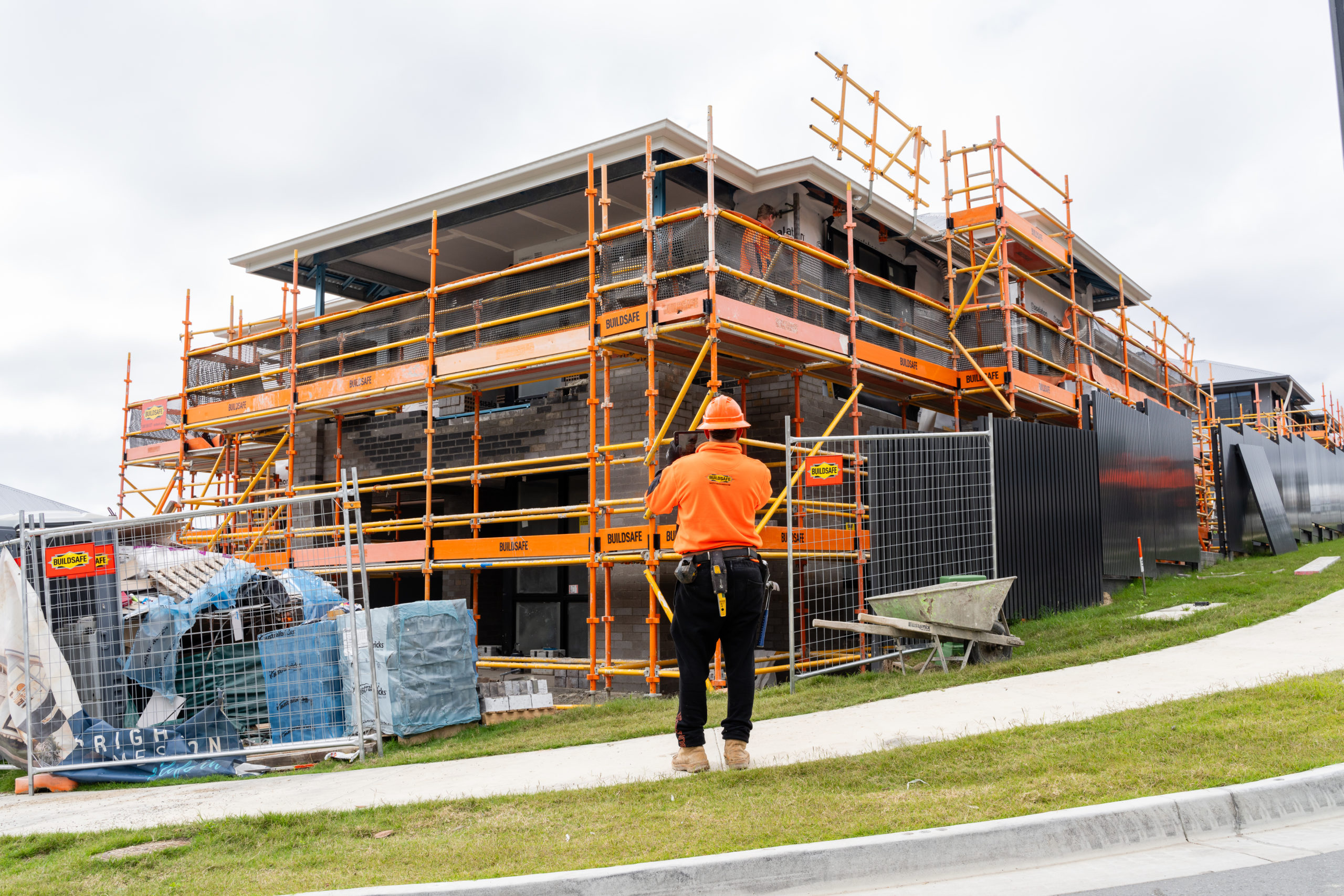
A commercial project has one principal contractor, a gated site and a supervisor whose whole day belongs to that job. A residential build has none of those things. Trades arrive on their own schedule, work for a few hours and leave, often without speaking to anyone.
So the structure gets adjusted by people who did not erect it and will not be there when it is next inspected. A bricklayer lifts a plank to land a pallet. A window installer swings a guard rail aside to get a frame through an opening. Neither is being reckless. Both are solving an immediate problem on a structure that is in the way.
The difference on a residential site is that nobody sees it happen, and nobody puts it back. The structure standing there no longer matches the design it was signed off against, and no document on site records the difference.
A Handover Certificate describes a moment, not a period
The Handover Certificate says the scaffold complied when a competent person inspected it, meaning someone with the knowledge, training and experience to inspect scaffold of that type. It is a statement about a point in time. Once a component moves, the certificate describes a structure that no longer exists, and the person who signed it has no way of knowing.
The regulatory position is more specific than most site teams realise, and it pays to read the original. Regulation 225 of the model Work Health and Safety (WHS) Regulations requires the person with management or control of a scaffold to hold written confirmation from a competent person that construction is complete before the scaffold is used, and then to have the scaffold and its supporting structure inspected by a competent person on three triggers: before use resumes after an incident that may reasonably be expected to affect stability, before use resumes after repairs, and at least every 30 days. Read the first two triggers carefully. They focus on events that change the structure, which is what an unrecorded alteration is.
Then read the scope, because this is the part that catches residential builders out. Regulation 225 applies to suspended, cantilevered, spur and hung scaffolds, and to any other scaffold from which a person or thing could fall more than 4 metres. A single-storey or low two-storey residential scaffold can sit under that threshold, in which case the 30-day statutory inspection cycle does not apply to it at all. That is not a licence to inspect less. It means the paperwork most sites lean on was never the control for that structure, and the general duty is doing all of the work. Sites commonly treat the 30-day tag as universal, and much industry guidance states it that way, which is why the scope is worth reading in the regulation itself rather than off a checklist.
Where regulation 225 does apply, the 30-day interval is a floor, not a schedule. If a tie comes out on day three, nothing in the cycle says so until day thirty.
The duty underneath the interval runs continuously. The model Code of Practice for managing the risk of falls at workplaces frames it as eliminating or minimising fall risk so far as is reasonably practicable, which does not reset at each scheduled inspection. A structure that was compliant on Monday and altered on Tuesday is not covered by Monday’s paperwork.
One more line of regulation 225 is worth having in mind when an alteration is found. If an inspection shows the scaffold or its supporting structure creates a risk, the necessary repairs, alterations, and additions must be made, and the structure inspected again before use resumes. Finding the change is not the end of the obligation; it is the start of one.
Four checks that close most of the gap
None of these needs a specialist. They need someone on site to check four specific things, not the scaffold in general.
Ties and their fixings come first, because a tie is removed for access and reinstated by nobody in particular. Walk the perimeter and count them against the erection drawing rather than judging by eye. AS/NZS 1576.1:2019 sets the general requirements the structure was designed against, and a tie pattern altered on site is a departure from that design rather than a variation of it.
Guard rails at openings are next. Window and door openings are where rails get swung aside to land a frame, and they are also the points where a fall has somewhere to go.
Planking continuity follows. Look for lifted, reversed or missing boards near material landing zones. A scaffold deck is specified to a duty rating, and a deck that is no longer continuous or no longer laid as designed is no longer the deck that rating was assigned to.
Base plates and soleboards close the list. On residential blocks, the ground moves. Rain, trenching and backfill all shift bearing, and a base that has settled on soft ground will not announce itself.
Put the record where the site can see it
Four checks against a dated note give you something a monthly certificate cannot: a continuous record, not a snapshot. This is the same discipline the Orange Box applies to site documentation, and it works for the same reason. The record lives where the work happens.
Name one person per site as the point of contact for scaffold changes, so alterations have somewhere to go. Treat a modification as a reportable event rather than a maintenance item, and record it against the Safe Work Method Statement (SWMS) for the task that caused it. As the person conducting a business or undertaking (PCBU) with management or control of the structure, that record is what demonstrates you were managing the risk rather than assuming it away.
Schedule inspections against build stages as well as the calendar, with frame-up and lock-up as the obvious tie points because they are the highest-traffic periods on the structure. A fixed cycle will always be out of step with a build that moves at its own pace, and the periods of greatest change are exactly the periods a fixed cycle handles worst.
The question worth asking your provider
Providers differ on what happens between scheduled inspections, and the difference rarely appears in the quote. Ask how a mid-cycle alteration is meant to be reported, who is authorised to reinstate a modified component and how quickly someone can attend.
Ask what the reinspection trigger is. Some providers treat any modification as a trigger; others work to a fixed cycle regardless. That answer tells you how much of the ongoing risk sits with you.
Then ask whether the system itself resists casual modification. Every alteration in this article starts the same way: a trade needs access to the structure that is currently in the way. A passive perimeter system, such as Perimeter Fallguard, addresses why the component gets moved rather than moving it. That is design substitution rather than an instruction not to touch things, and the hierarchy of controls has an opinion about which of those two holds up on a site nobody is watching.
Where to start
Pick one active site and reconcile the structure standing today against the last Handover Certificate. Whatever that exercise finds, you will know whether the gap is real on your sites rather than in general.
A compliant build from the outset is not a document. It is a structure that still matches its design on day thirty. If you want scaffolding sequenced around your build stages rather than a fixed calendar, talk to our team. More practical guidance sits in our articles and resources.
Standards and regulatory references in this article are current as at 14 August 2026, and the regulatory references are drawn from the model WHS Regulations as adopted in the harmonised jurisdictions. Check the version in force in your own state, and the edition of any standard in force for your structures, before you write either into a procedure.