Buildsafe’s Height Safety Advantage
How engineered, trade-friendly systems are reshaping residential construction safety and productivity
When conversations turn to safety in residential construction, the focus often lands on compliance: meeting standards, passing audits, and ticking boxes.
But according to Buildsafe National Services Manager Bo Ceprnja, edge has always been about something more practical; building systems that trades actually use, that builders can rely on, and that make sites safer and more efficient.
Across Buildsafe’s platform offering – from stair void protection to cantilevered roof access – the common thread is clear: engineered solutions designed around real site behaviours, and supported by training, auditing and install methodology that reduces the most dangerous variables in height safety.
The shift from “fall protection” to “load-bearing working platforms”
Bo draws an important distinction between traditional edge protection and the platform systems Buildsafe has developed.
Edge protection is largely a single-purpose safety system: it’s there “when you’re falling,” and its job is to prevent the fall from becoming catastrophic. Platform systems are different. They’re load-bearing, meaning they function as the primary surface other trades work from — and they still need to protect against falls.
That dual role changes everything. It means the product must perform safely every minute it’s being used, not only when something goes wrong.
The Void Platform: solving one of the most dangerous openings on site
The stair void is one of the most common — and most dangerous — hazards in multi-level home builds. Once the first floor is installed, the stair opening can represent a fall of two metres or more, and in many builds, closer to three metres depending on ceiling heights.
Bo explains the problem isn’t theoretical. It’s behavioural and environmental:
- trades are carrying materials
- focus is on balance and movement, not the hole behind them
- sawdust and debris can make the perimeter slippery
- one step backward can become a serious incident
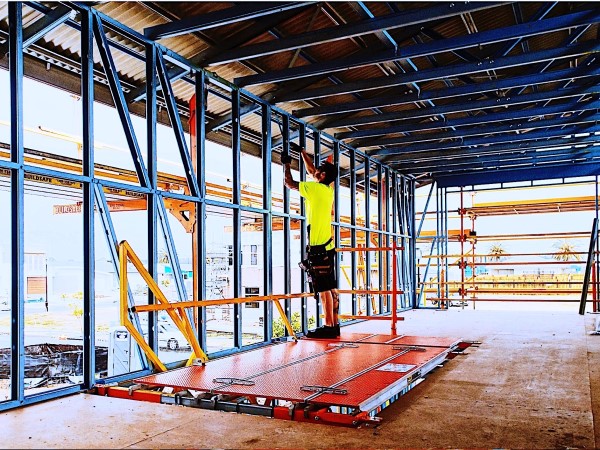
Buildsafe’s Void Platform was built to prevent that exact scenario — and has evolved through “many, many iterations.” The current system, Bo notes, is now far beyond a basic cover.
Where early versions relied on plywood and steel framing, the modern void platform uses composite fibreglass decking with aluminium or steel subframes — a shift that improves performance consistency and on-site usability.
Bo highlights several reasons this matters in practice:
- the material allows a custom non-slip surface
- the system’s uniformity creates predictable performance
- components are easier to replace, repair and maintain
- the product’s design supports a more defined lifespan and durability profile
But the key operational difference is this: Buildsafe’s void platform is a manufactured engineered system designed to work across any stair void shape, while maintaining compliance around critical allowable gaps.
As Bo puts it, a void cover could be made from “paper bags if it’s strong enough” — the material isn’t the point. The point is that Buildsafe’s approach ensures the platform is fit-for-purpose, compliant, and adaptable, where rudimentary plywood alternatives can struggle to meet standards consistently, especially when voids are complex.
Void Platform Stairs: the award-winning upgrade to ladder access
Traditionally, stair void platforms are accessed via a ladder through a small hatch — and while that can prevent falls through the void, it creates a new challenge: awkward, inefficient access while carrying tools and materials.
Buildsafe’s answer was the Void Platform Stair System: a temporary stair solution connecting ground to first floor through the void platform.
Bo notes the innovation was formally recognised, with Buildsafe’s void platform stair solution winning a Safety Council of Australia Award for Excellence in Safety, including the overall award.
The strategic value is clear:
- stairs reduce awkward ladder climbs
- access becomes more efficient for modern build schedules
- safety improves as movement through the void becomes controlled
As houses grow larger, density increases, and safety expectations continue to rise, relying on ladder access through narrow openings becomes harder to justify.
As such, the void platform stairs are well positioned to become the new gold standard.
“Turnkey” isn’t the product - it’s the system behind it
One of Bo’s strongest points is that the physical product is only part of the Buildsafe value.
Yes — the platforms are designed to be installer-friendly, intuitive, and difficult to assemble incorrectly. That matters because in construction, install time and error rate directly affect cost, safety, and scalability.
But Bo is direct: what makes Buildsafe competitive is the supporting foundation behind the product:
- training
- auditing
- install methodology
- systems that turn “uninitiated” installers into competent ones quickly
The platform is the visible piece. The operating model — ensuring compliance and correct configuration every time — is “what actually makes a really cool and user-friendly and practical and functional product commercially really competitive.”
Hang-On: the “beating heart” of Buildsafe
If the void platform protects inside the structure, Hang-On solves one of the biggest constraints outside it: modern site footprint.
Bo describes Hang-On as “quintessential Buildsafe” — the most iconic product and the nucleus of the entire product offering.
Hang-On is a highly engineered cantilevered platform designed to replace traditional scaffold for key stages, especially work around:
- roof
- fascia
- gutter
The commercial driver is simple: homes are bigger, lots are smaller, and setbacks are tight. Builders increasingly struggle with site congestion and materials movement.
Hang-On addresses this by:
- sitting up and away from the ground
- taking minimal site footprint
- installing quickly for short-duration stages
- improving access for roof-line works
- helping builders hit schedules faster
Bo frames it as a strategic advantage: if builders use Hang-On within a risk management plan, it can make them more competitive, because the build moves faster and material logistics improve.
And crucially, Hang-On is what enables Buildsafe to deliver more of its ecosystem. Once Hang-On is adopted, it becomes easier to deploy transitions, internal systems, stairs, and additional protection solutions. In Bo’s words: without Hang-On, other products “don’t work as well.”
Safe installation: the unspoken differentiator
Hang-On’s performance during use is one part. But Bo flags another factor as central: installation and dismantle.
He notes Hang-On is dangerous to install without the right method, so Buildsafe’s advantage has been engineering the product around safe installation and removal – reducing worker exposure to fall risk during the most hazardous part of the lifecycle.
He stops short of making an absolute claim, but shares his view based on experience: Buildsafe’s approach may be among the only systems that enables safe install and dismantle without exposing workers to falls in the way some competing systems can.
Scaffold, reimagined as part of a complete system
Buildsafe didn’t start as a scaffold business – but as Bo explains, scaffold has become increasingly central because Buildsafe can now deliver complete transitions from one system to another across build stages.
Rather than scaffold being “the whole solution,” Buildsafe positions it as part of a staged, integrated approach — supplementing scaffold’s downsides with other products and integrating it into a broader edge protection strategy.
Bo points to several differentiators:
- Buildsafe uses a quick-stage aluminium scaffold system
- aluminium provides manual handling advantages
- install can be faster than traditional steel scaffold
- scaffold can be deployed in specific windows, then removed to free the site, then redeployed later
The value sits in Buildsafe’s ability to transition seamlessly between systems — scaffold to roof access, roof to edge protection, and from one stage of works to the next.
Roof walkway boards: protecting modern roofs from costly defects
In a practical aside, Bo highlights an often-overlooked issue: roof damage from foot traffic.
Micro-cracking isn’t just a tile problem – it applies to tin roofing too, and in some cases, it’s even more critical. If Colorbond is dented, the visual blemish can compromise warranty expectations and require full sheet replacement – sometimes even the entire roof section.
Walkway boards are designed primarily for tin roofs (while still applicable for tiles), and Bo notes tin roofing is increasingly dominant in the industry – making this protection more relevant over time.
The bigger picture: engineered compliance that works on real sites
Across the product suite, Bo’s message is consistent: Buildsafe’s advantage is not just having good equipment; it’s delivering engineered, adaptable systems that are:
- compliant across varying site conditions
- intuitive to install
- hard to assemble incorrectly
- supported by auditing and training
- designed around real trade behaviours
- aligned to the commercial realities of construction scheduling
For builders and trades, that combination translates to a rare outcome: safer sites without slowing work down and in many cases, a faster, more efficient build.
Why Builders Choose Buildsafe
Buildsafe is Australia’s trusted partner in residential construction safety, delivering innovative access and protection systems including edge protection, temporary fencing, void protection, and the industry-leading Walkway Board system.
For more information, visit www.buildsafe.net.au or contact info@buildsafe.net.au.
About Buildsafe
With a reputation for innovation, reliability and worker protection Buildsafe offers superior safety solutions, where you can be sure of a compliant build from the outset. From our specially designed and engineered products right through to our responsive operations team, we have every stage of your build covered.
With a footprint covering much of Australia’s east coast, Buildsafe works very closely with those in the construction industry to provide safety solutions to everyone, from owner builders to major site developers; we have all your safety needs covered.
For more information, visit buildsafe.net.au.
For media inquiries please contact: media@buildsafe.net.au